1066 and All That
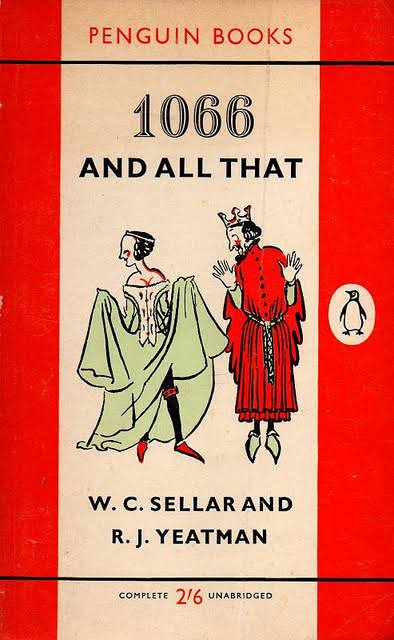
The history I learned at school has gradually become rather hazy, in line with Sellar and Yeatman’s wonderfully comic 1066 and All That. About the Anglo-Saxons, who lived in England from around 450 CE till 1066 CE, they write:
‘Ethelread the Unready was the first Weak King of England and was thus the cause of a fresh Wave of Danes. He was called the Unready because he was never ready when the Danes were. Rather than wait for him the Danes used to fine him large sums called Danegeld, for not being ready. ... Finally, Ethelread was taken completely unawares by his own death and was succeeded by Canute. ...
On his death Canute’s Kingdom was divided between two further sons, who had previously been overlooked, Aftercanute and Harold Harebrush. These were succeeded by Edward the Confessor... Edward the Confessor ... was in the habit of confessing everything whether he had done it or not, and was thus a Weak King.’
You can read the whole text, with helpful explanations of their muddled events, here.
Weak or not, Edward’s death without children led to dispute about his successor. Contemporary French historians claim that two years before, King Edward sent Earl Harold Godwinson to swear on oath to William, the Duke of Normandy (in present-day France), that William would be Edward’s successor. After all, William was a distant cousin of Edward. When Edward died, however, Harold himself became king.
In support of Harold, the English account in the contemporary Anglo-Saxon Chronicle says:
‘But the prudent king [Edward] had settled the realm on high-born men -- on Harold himself, the noble earl; who in every season faithfully heard and obeyed his lord, in word and deed; nor gave to any what might be wanted by the nation's king. This year also was Earl Harold hallowed to king; but he enjoyed little tranquillity therein the while that he wielded the kingdom.’
Very little tranquillity indeed. William, incensed, invaded England and defeated Harold at the Battle of Hastings in 1066.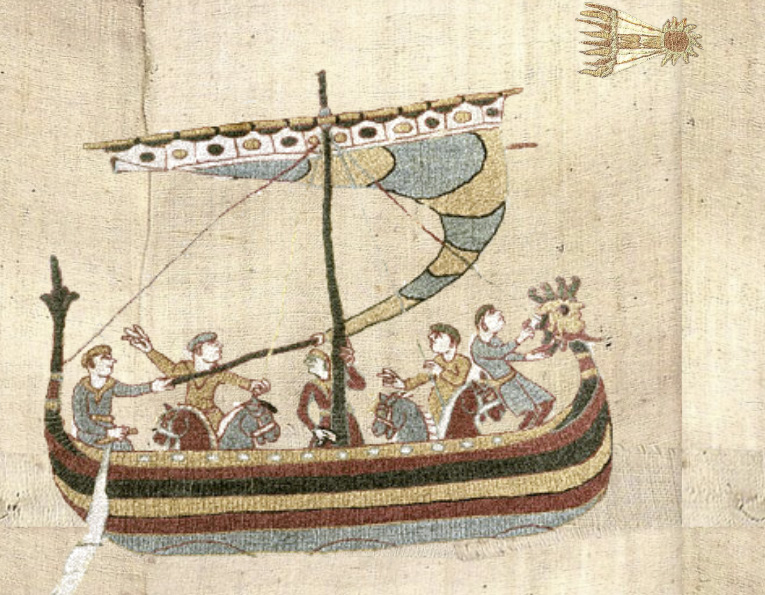
I was intrigued that the Anglo-Saxon Chronicle, after a detailed description of the Battle of Stamford Bridge, famously fought by Harold against the King of Norway who had invaded the North of England, devotes only a few lines to the even more momentous Battle of Hastings. This took place nineteen days later after Harold marched his army south on hearing of William’s invasion. The French sources are more forthcoming, but the most vivid depiction is in the Bayeux Tapestry.
The Bayeux Tapestry provides a remarkable visual record of the battle itself and the events leading up to it. A wonderful array of people, horses, boats, buildings and beasts leads the viewer through the story. Each figure has an individual personality. Every horse has an expression. It is a truly magnificent work, both moving and, at times, humorous.
No one knows who commissioned the Tapestry, but Bishop Odo of Bayeux in Normandy, William’s half-brother, is a strong contender. The sewing, however, was probably done in Canterbury, since English embroiderers were famed throughout Europe for their skill.As many people will tell you, the Bayeux Tapestry is not an actual tapestry; it’s a wool embroidery on a linen background nearly seventy metres long. And the final part is missing. This missing section is thought to depict King William on his throne. But what happened to that section? As a writer of crime fiction, I had to account for it.
The remarkable thing about the Tapestry is that although it was commissioned to commemorate the Norman victory, the first third of the story concentrates on Harold; William’s invasion doesn’t start until halfway through. This suggests strongly that the work is not just designed to glorify the winners. Recognition of English valour is interwoven throughout the main story and in the upper and lower borders. Many elements can be taken in several ways, supporting, mocking or criticising the victors. For example, one of the saddest scenes is the eviction of an English woman and her son from their house, which is then torched by soldiers (scene 47). Is this a celebration of Norman victory, or a condemnation of the invaders’ inhumane treatment of the local population?
Learning about this and subsequent events gave me a stronger sense of the impact of the invasion, especially when I read about the Harrying of the North in 1069–70. William’s response to a rebellion in the North of England was out of all proportion to the provocation. The area affected was huge, including Yorkshire and Durham and stretching to Chester and Shrewsbury in the west. Even one of William’s strongest supporters, contemporary historian Orderic Vitalis, criticises him: ‘My narrative has frequently had occasion to praise William, but for this act which condemned the innocent and guilty alike to die by slow starvation I cannot commend him.’
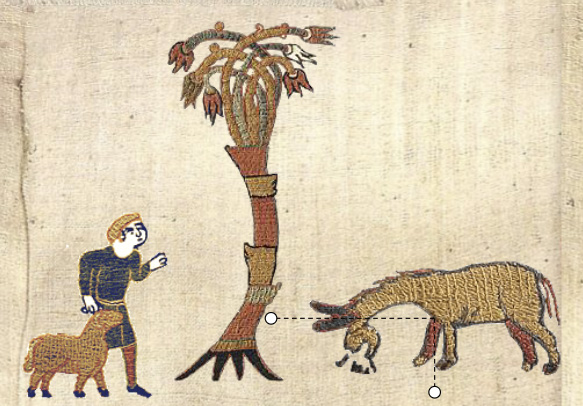 The Harrying of the North is one of the grimmest times of William’s reign. Other facts I learned about the Anglo-Saxons were much more cheering. Future blog posts will give some highlights from my research on the Tapestry, some funny, some sad, some mysterious.
The Bayeux Tapestry is currently on loan to the British Museum until renovations at its home in Bayeux are completed later in 2027. I gather that tickets to see the Tapestry in London are in great demand, but you can see the whole work online at the Bayeux Tapestry Museum website. When you’ve seen the original, why not play around with the elements and invent your own story? The Tapestry pictures in this blog entry were created using the Historic Tale Construction Kit. (Thank you to Leonard, Mathieu and Maria for sharing your coding expertise.)